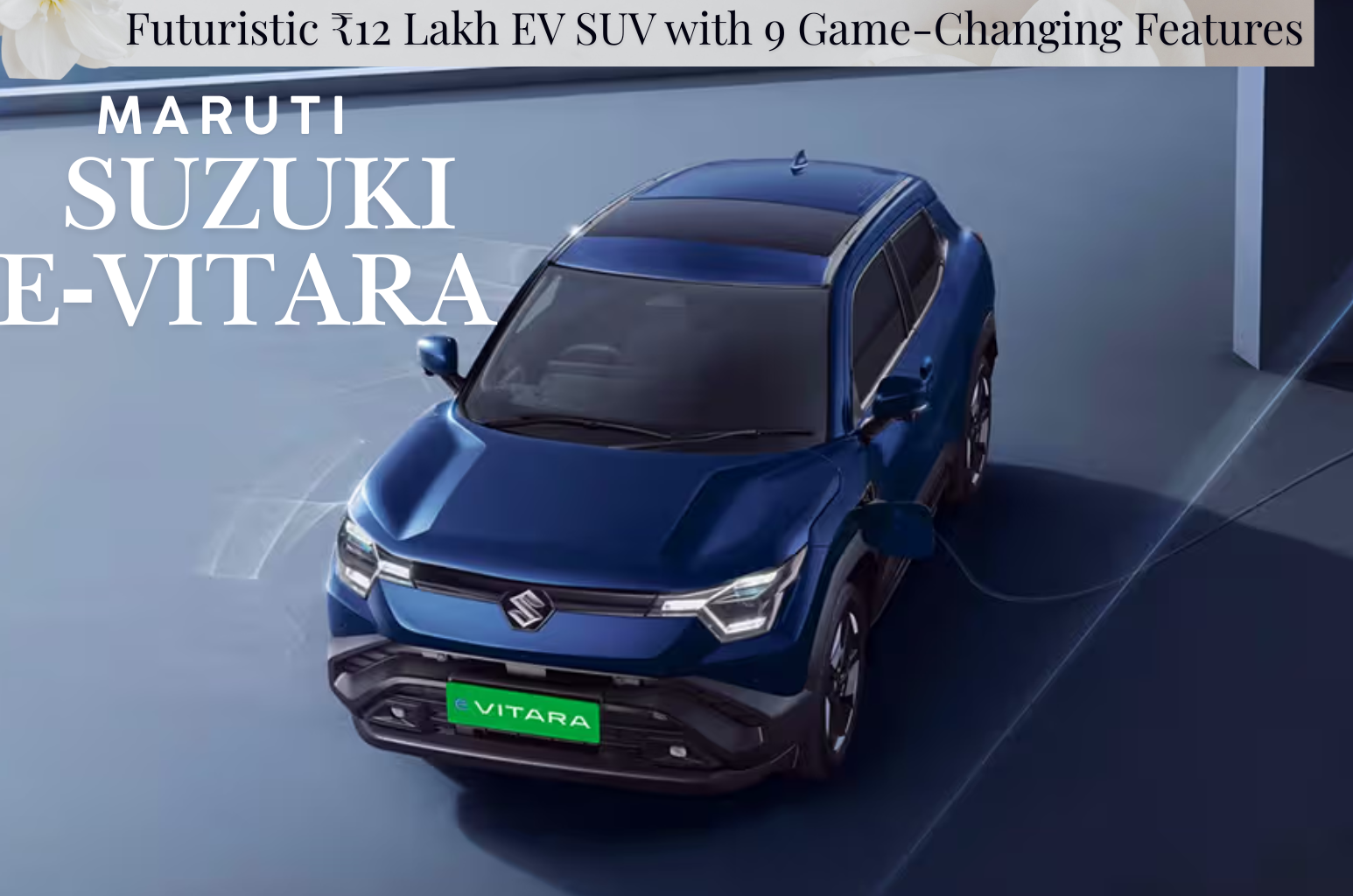
Maruti Suzuki e‑Vitara is finally entering the game with its much-anticipated e‑Vitara. As India’s largest car manufacturer, the company’s foray into the EV market signals a shift toward a cleaner, greener future. The e‑Vitara is expected to redefine affordable electric mobility by combining Toyota Maruti’s well-known reliability with modern EV technology. Developed in collaboration with , this SUV is a crucial part of Maruti’s strategy to deliver high-volume electric vehicles starting in 2025. Positioned to cater to eco-conscious yet budget-sensitive Indian buyers, the e‑Vitara might become the face of mass EV adoption across the country.
Exterior Design: Aerodynamic Body & LED DRLs
Sporting a closed grille and optimized drag coefficient, the e‑Vitara’s design reflects function and form. EV-specific styling like blue accents, LED Daytime Running Lamps (DRLs), and flush door handles improve efficiency while giving it a futuristic look. Alloy wheels are likely to be aero-tuned to reduce turbulence and boost range.
Infotainment & HMI (Human-Machine Interface)
Inside, the dashboard will feature a floating touchscreen infotainment system, equipped with Maruti Suzuki e‑Vitara’s Smart Play Pro+ OS. The interface supports wireless Android Auto/Apple CarPlay, voice recognition, and over-the-air (OTA) software updates. Expect a digital instrument cluster and a responsive Human-Machine Interface (HMI) layout for easy access to EV-specific data like charge status and energy consumption.
Battery Pack & BMS Integration
The e‑Vitara is anticipated to include a lithium-ion battery pack with a Battery Management System (BMS) to optimize performance, lifespan, and thermal control. Capacity will be in the 40–45 kWh range, offering a real-world range of 350–400 km. The battery is likely IP67 rated for water and dust resistance—ideal for Indian conditions.
Powertrain & Drive Modes
This electric SUV will house a Permanent Magnet Synchronous Motor (PMSM), delivering instant torque and smooth acceleration. Power output may range between 100–130 bhp. Expect multiple drive modes (Eco, Normal, Sport), regenerative braking, and possibly hill hold assist, giving drivers full control over performance and efficiency.
ADAS & Active Safety Systems
Advanced safety features are expected, including Advanced Driver Assistance Systems (ADAS) like Lane Departure Warning, Adaptive Cruise Control, and Automatic Emergency Braking (AEB) in higher trims. Core safety specs will include ABS with EBD, dual front airbags, rear parking sensors, and electronic stability control (ESC).
Variants, Pricing & Platform Rivals: Suzuki e‑Vitara
Maruti will likely offer multiple trims, with pricing between ₹12–18 lakh (ex-showroom). It will compete with Tata Nexon EV Gen2, MG ZS EV, and Hyundai Kona Electric. Thanks to localized manufacturing and shared development with Toyota, the e‑Vitara may undercut rivals while offering comparable tech.
Charging Infrastructure & Onboard Charger
The e‑Vitara should support DC fast charging (likely 30–50 kW) and AC charging with a standard Type 2 connector. A bundled 7.2 kW onboard charger could enable overnight home charging, while fast chargers may allow 0–80% top-ups in under 60 minutes. Maruti plans to expand its EV service ecosystem with partner-based charging networks.
Verdict: A Future-Ready“ Maruti Suzuki e‑Vitara
With robust battery specs, modern UI/UX systems, OTA-enabled software, and affordable pricing, the Maruti Suzuki e‑Vitara could democratize EV ownership in India. Its integration of power electronics, smart features, and ADAS positions it as a well-rounded urban and intercity EV option for eco-conscious drivers.
FAQs about Maruti Suzuki e‑Vitara
Q1: Does the e‑Vitara support OTA updates?
Yes, for infotainment, navigation, and system diagnostics.
Q2: What is the battery range of the e‑Vitara?
Around 350–400km per charge (real-world).
Q3: Can I use the e‑Vitara to power gadgets?
Yes, it may support Vehicle-to-Load (V2L) in higher trims.
Q4: What motor type is used?
A PMSM (Permanent Magnet Synchronous Motor).
Q5: Will it have ADAS features?
Likely in top variants, including lane assist and adaptive cruise.