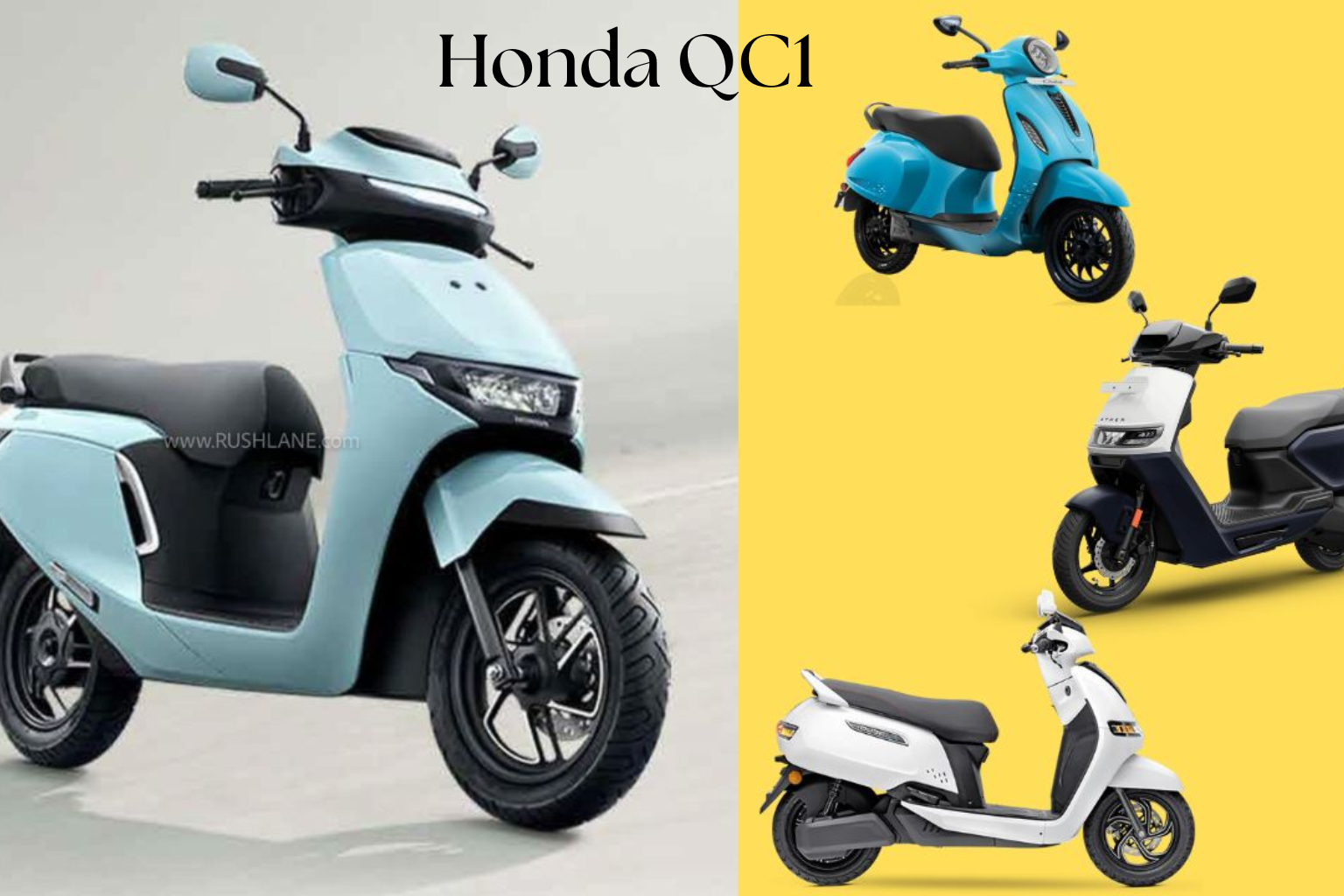
The Honda QC1 is Honda’s latest venture into the growing electric two-wheeler segment in India, aimed squarely at the budget-conscious commuter. Unlike their premium offering, the Activa e, the QC1 strips down on frills while retaining Honda’s legendary reliability and solid engineering. Launched during the 2025 Bharat Mobility Expo, the QC1 represents Honda’s strategy to build an accessible and smart EV ecosystem tailored for India’s unique traffic, economic, and infrastructural conditions.
Battery & Motor Specifications
Under the sleek body lies a robust yet compact 1.5kWh lithium-ion battery paired with an in-wheel brushless DC motor. This motor produces a rated power of 1.2 kW and peaks at 1.8 kW, which is sufficient for quick starts and moderate climbs typical of urban routes. The power delivery is smooth and silent, perfect for weaving through traffic or riding early in the morning without noise disturbance. Unlike performance-oriented e-scooters, the QC1 doesn’t chase speed; instead, it emphasizes energy efficiency and reliable performance over time.
Charging Times & Home Charging Setup
Charging the Honda QC1is refreshingly straightforward. It comes with a 330W off-board charger that plugs into any standard 5A socket. From empty to 80% takes approximately 4.5 hours, while a full charge takes about 6.5 hours. This overnight charging profile fits naturally into the routines of most users—just plug it in before bed, and it’s ready for the next day. However, the absence of fast charging means users must plan their rides thoughtfully, especially if the day involves multiple errands. There is no provision yet for public charging compatibility or battery swapping stations, signaling that Honda is targeting riders who can charge at home or work.
Performance & Range
Honda claims the Honda QC1 delivers an impressive 80km on a full charge in Eco mode, although real-world usage suggests a more realistic figure of around 50 km when ridden in Standard mode. For many riders in congested urban environments, this range is perfectly adequate, especially when daily commutes rarely exceed 25–30 km. The performance is tuned for stability, not speed. Acceleration is steady and predictable, allowing new riders to feel confident without being overwhelmed. Standard mode offers better throttle response and a top speed of 50 km/h, while Eco mode maximizes .
Riding Modes : Honda QC1
The Honda QC1 offers two riding modes—Eco and Standard—that balance performance with battery conservation. Eco mode is designed for maximum mileage and is ideal when riding on flat terrain or in stop-and-go traffic. However, its speed limit of 30km/h can feel sluggish on main roads. Standard mode, on the other hand, provides quicker acceleration and unlocks a top speed of 50km/h. This makes it more practical for slightly longer trips or stretches where traffic moves faster.
Dimensions & Ergonomics
The Honda QC1 is incredibly user-friendly in terms of dimensions. Weighing just 89.5kg, it is easy to maneuvers in tight parking spaces and narrow lanes. Its low seat height of 769mm makes it accessible to riders of all heights, including women and senior citizens. With a 1,230mm wheelbase and 169mm ground clearance, it handles speed bumps and potholes gracefully. The footboard is wide enough to accommodate grocery bags or a backpack, while the seat cushion offers enough space for two average-sized adults.
Conclusion
The Honda QC1 stakes its claim as a no‑frills, economically priced electric scooter ideal for short‑distance city commutes. While performance and features are limited compared to premium EVs, Honda’s reputation for durability and a solid warranty make it a compelling option for budget-conscious urban riders.
For riders who prioritize speed, range, or connectivity, competitors such as the Activa e, TVS iQube, or Ola S1 X may be better alternatives.